In lieu of another question from me, I am turning this spot over to another PFA member, Gary Paisley. His essay below is especially relevant today as this is the 242d anniversary of the Battle of Guilford Courthouse. Thanks, Gary!
(This essay also appears on the PFA History Page under American Revolution)
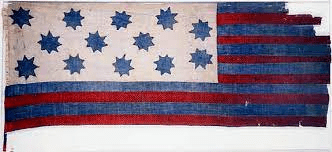
Meaning of the Flag by Gary Paisley
The display of the tattered flag replica above and on the PFA’s Charter page begs for explanation. This was the flag of the Guilford County (North Carolina) Militia, active during the American Revolutionary War. Under these colors, several of our own ancestors fought for our independence. These ancestors included brothers, Colonel John Paisley, Captain Robert Paisley, William Paisley, and their younger cousin John Paisley.
Among their various exploits, all four of these ancestors of ours fought at the Battle of Guilford Courthouse, on ground located within present-day Greensboro, in a battle that was, more recently, loosely depicted in the Hollywood film, The Patriot. But, despite Hollywood’s inaccuracies, the heroism displayed that day by our ancestors was real.
William Paisley and the younger John Paisley both fought in a militia company under the command of Captain Arthur Forbis. They were in the first of three lines of American troops, and were deployed along a split-rail fence as 2,500 British regulars under the command of Lord Charles Cornwallis bore down on their position on the morning of 15 March 1781. Forbis’ orders were to have his men fire a volley, reload their rifles, and fire second and third volleys, before falling back to the second line of American troops.
As the British marched towards them, and as artillery fire from 6-pounders on both sides rained down and exploded within their lines, several companies of North Carolina Militia broke and ran without firing a single shot. But Captain Forbis’ men, including William and young John, stood their ground and fired into the advancing British line with such deadly accuracy that, according to the British, their fire dropped half of the Fraser’s Highlanders regiment on the spot. They then maintained their stand for the necessary minute-plus time required to reload, all the while receiving incoming musket fire from the British, and fired again into the British troops who were, by then, charging with their bayonets. Their second volley momentarily stymied the British.
But, as a result of the action, Captain Forbis lay mortally wounded, and William Paisley was shot through the hand by a British musket ball. John Paisley later stated in his war pension application that before Captain Forbis died, he “received his gospel from him”. Despite their casualties, the Guilford Militia continued to hold their position, their guns resting at the ready on the rail fence, knowing they were about to be overrun and killed by the British 23rd Royal Welch Fusiliers regiment. It was at this moment when they were, mercifully and directly, ordered to withdraw by General Nathaniel Greene, the overall commander of the American forces.
The British then continued their advance, and the Battle of Guilford Courthouse became, technically, a British victory in that they ultimately forced the American troops to leave the field. However, British casualties from the battle were so severe that Cornwallis, his army reduced to 1,400 effectives, was forced to withdraw to Yorktown where he hoped his remaining army could be taken away by British warships. But, at Yorktown awaiting rescue, his army was surprised and surrounded by American and French troops, forcing his surrender and effectively ending the war.
Cornwallis himself later begrudgingly admitted respect for the Guilford Militia, calling them “the Irish line of the American Army”. For us, it is directly because of the heroism of these, our ancestors, that we enjoy the freedoms we have today. And, through many of our PFA activities including our DNA project, and our ancestral database project, we pledge to never forget their sacrifice.
 Paisley Family Association